BENDYWOOD® = COMPRESSED WOOD IN LENGTH.
For a detailed description, see the following link:
What is Bendywood®?
RAW MATERIAL SECTIONS:
They are high-quality blocks of 120x120 mm and 60x120 mm, sawn from the hardwoods:
Beech, Maple, Ash, White Oak, Red Oak, Cherry, and Walnut.
BENDYWOOD® LENGTHS:
The finished compressed lengths range from 400 mm up to 1650 mm in the 120x120 mm
section and from 400 mm up to 1500 mm in the 60x120 mm section.
The lengths for bending go up to 12.0 m: they are jointed lengths.
BENDYWOOD® SECTIONS:
Sections of 50x50 mm and 100x50 mm are available in all wood species,
plus 80x50 mm and 60x60 mm sections in beech only.
See pages 8 + 10 + 16 + 17 of the catalog.
Bendywood® is used for handrails, various furniture and musical instruments.
To see examples of use:
Curved bending handrails
Other applications
HOW TO MACHINE BENDYWOOD®
Bendywood® is steam-treated wood, compressed in length and dried.
To remain in its compressed length, it must not come into contact with water.
If water penetrates, it will expand in length and shrink again once it has dried.
The surface will become rough and will need to be sanded and varnished again.
For this reason:
DO NOT USE BENDYWOOD® OUTDOORS, IT IS NOT WATER-RESISTANT.
CAUTION WITH BUTT JOINTS!
BENDYWOOD® IS NOT LENGTH-STABLE!
Bendywood® is wood compressed in length, which makes it denser than regular wood.
For this reason, the following is recommended for processing:
SAWING AND SANDING:
Can be done as with normal wood.
PLANING AND ROUTING:
These tasks should only be carried out with well-dried wood (approx. 8%).
Do not work against the grain: first try on the surface planing machine in which direction the wood can be worked best.
When milling, use high speeds, preferably 12,000 rpm; HSS cutters are ideal to avoid tear-out.
Mill profiles with a small cross-section on the edges of strips, then cut them off on the circular saw.
INCREASE THE WOOD MOISTURE TO 12% BEFORE BENDING:
To see how it works, consult the following link:
Bend / Moisten
Bending wood with a moisture content of approx. 12% not only makes bending easier but also stabilizes
the bend when the wood dries, as it reduces the springback forces.
GLUING IN THE LONGITUDINAL FIBER DIRECTION:
Use D4 polyvinyl glue, polyurethane glue, or resin-based glue.
Never glue simple butt joints, as they will open up over time.
Butt joints – if unavoidable – must be secured with 10 to 12 mm thick and 100 mm long dowels
on each side due to the longitudinal shrinkage of Bendywood®.
The long dowels made of normal wood, glued with D4 adhesive, prevent the end parts from shrinking!
This is also the reason why the dowels should be at least 10 mm thick.
This involves effort, which is why it is recommended, whenever possible,
to glue along long angled cuts lengthwise:
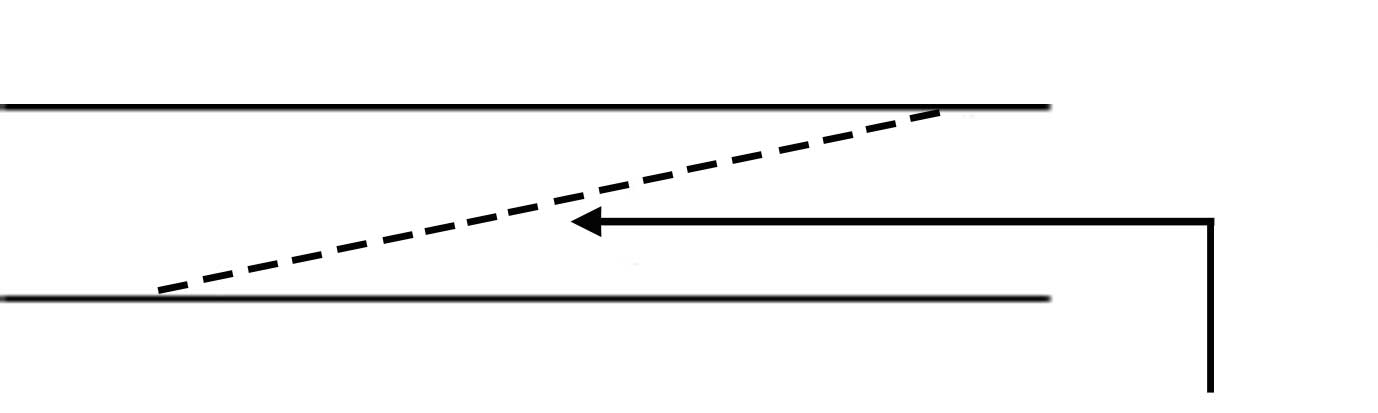
The angled cuts should be approximately 3 times as long as the thickness of the profiles.